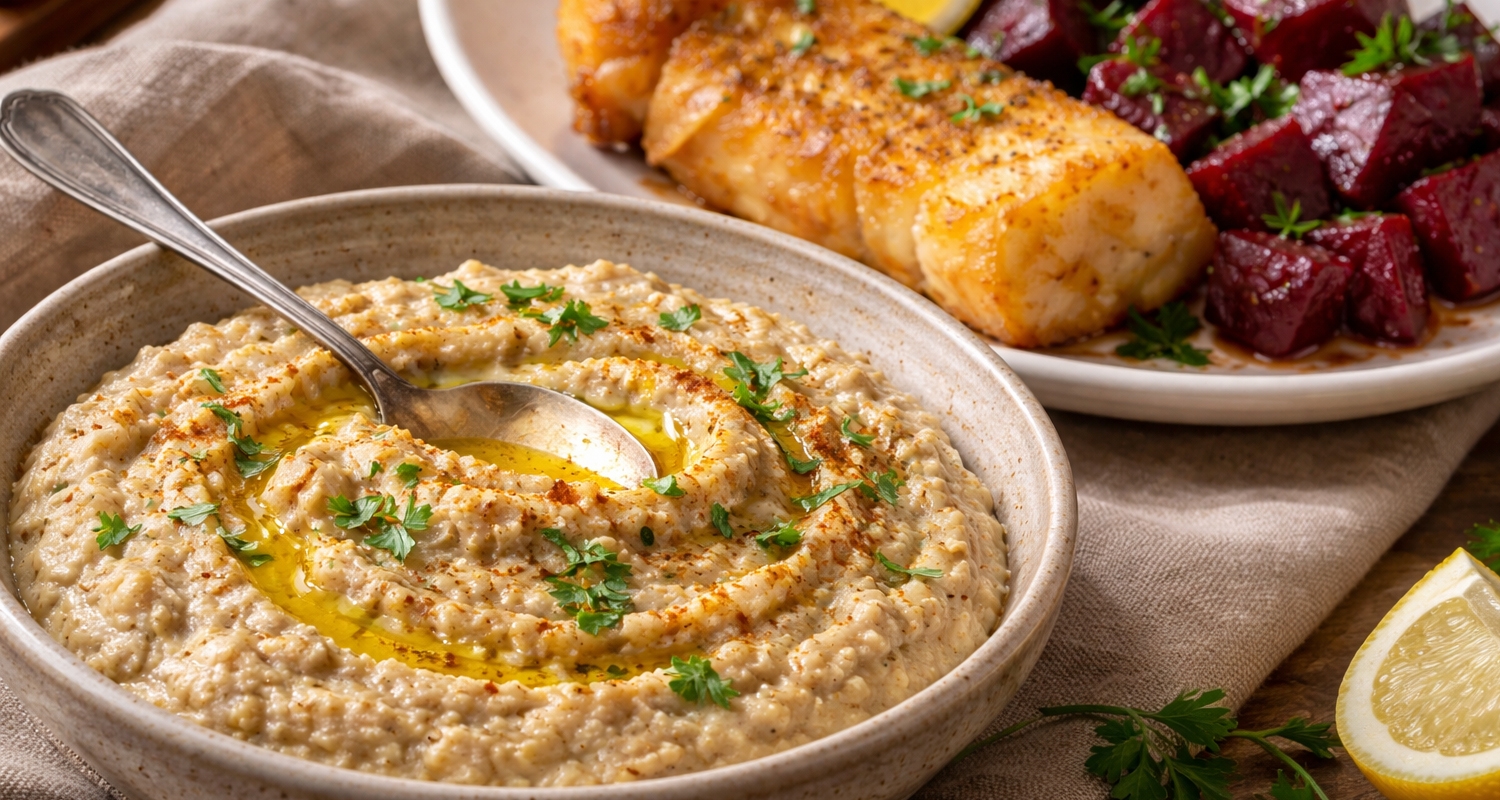
If you want traditional skordalia with walnuts, you need technique, balance, and patience. I follow a Northern Greek method that builds structure step by step. First, I create a stable emulsion. Then, I add the bread gradually. Finally, I fold in the walnuts to control texture. As a result, this Greek garlic dip stays creamy, stable, and full of flavor—especially when served with fried cod.
Why this method works
First, I build the emulsion before adding any starch. Then, I control the hydration carefully. As a result, the skordalia stays smooth and never becomes heavy. Also, adding walnuts at the end preserves texture and prevents oil separation. Therefore, the final dip holds its shape and delivers a clean, balanced flavor.
Ingredients overview
Key components
- Bread gives body and structure
- Garlic defines the flavor
- Olive oil creates richness
- Vinegar balances the intensity
- Walnuts add texture and depth
Because each ingredient plays a role, the method matters just as much as the ingredients.
Step-by-step method overview
Core technique
- First, prepare and squeeze the bread thoroughly.
- Then, pulse the walnuts separately.
- Next, build the garlic and oil emulsion.
- After that, add the bread gradually.
- Then, balance with oil and vinegar.
- Finally, adjust texture and fold in walnuts.
Because of this sequence, the dip stays controlled and consistent.
Texture control
What you’re looking for
- Thick but spreadable
- Smooth base
- Slight walnut grain
How to adjust
- If too thick → add a little water
- If too loose → add more bread
- If too heavy → add a splash of vinegar
As a result, you can fine-tune the texture without starting over.
Serving with fried cod (μπακαλιάρος τηγανητός)
I always serve this skordalia with fried cod. The crispy fish contrasts perfectly with the creamy dip. At the same time, the walnuts soften the garlic and add depth. Therefore, this pairing feels complete and balanced.
Personally, this is one of my favorite combinations. Whenever I make it, I go straight for warm bread, skordalia, and freshly fried cod.
History and origin
Skordalia has deep roots in Greek cuisine. Originally, it started as a simple garlic-based mixture. Over time, different regions adapted it. In Northern Greece, cooks added walnuts, which created a richer and more stable version. Traditionally, people prepared it in a mortar, so the texture stayed rustic. Today, blenders simplify the process, but the core technique remains the same.
Tips for better results
Pro tips
- Always squeeze the bread very well
- Always build emulsion before adding bread
- Always add walnuts at the end
- Use vinegar for a traditional flavor
- Let the dip rest before serving
Because of these details, the final result improves significantly.
FAQ
Why add walnuts at the end?
Because they preserve texture and prevent the dip from becoming too smooth.
Why use less water?
Because lower water keeps the structure stable and improves consistency.
Can I make it ahead?
Yes, and it actually improves after resting for a short time.
Should it be very smooth?
No, traditional skordalia should have slight texture.
Full recipe
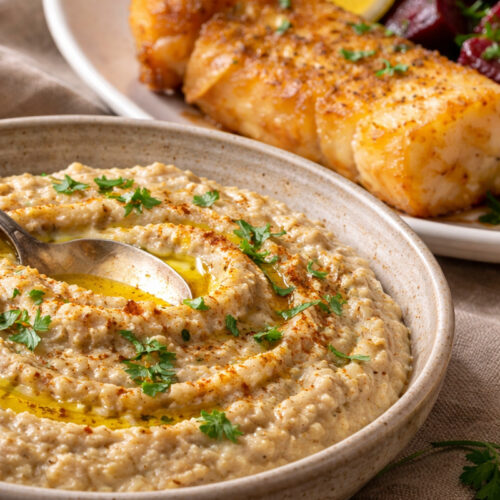
Traditional Skordalia with Walnuts (Greek Garlic Dip)

Equipment
- Blender
- Food Processor
- Mixing bow
Ingredients
- 500 g white bread no crust, soaked and squeezed
- 100 g walnuts pulsed, not paste
- 8 garlic cloves
- 260 ml olive oil
- 50 ml vinegar
- 150 ml water
- 1¼ tsp salt
Instructions
Prepare the bread properly
- Soak the bread in water for 1–2 minutes until soft. Then squeeze it very firmly with your hands until almost dry.• The bread should feel damp, not wet. • Excess water will ruin the texture later. • This step controls the final texture more than anything else.
Prepare the walnuts (texture control)
- Add the walnuts to a food processor and pulse in short 1–2 second bursts.Stop when they look like:• coarse crumb• sslightly uneve• not oilyDo not turn them into paste. Set aside.
Start the base (garlic + salt + oil)
- Add garlic and salt to the blender with about 20% of the olive oil (~50 ml).Blend for 30–40 seconds until:• Scrape down the sides if needed• completely smooth• creamy• no visible garlic pieces
Build the emulsion (critical stage)
- With the blender running, slowly pour in another 20–30% of the olive oil (~70–80 ml) in a thin stream.the mixture should:• thicken slightly• turn pale• look creamyThis step creates a stable base and prevents separation later.
Add the bread gradually
- Add the squeezed bread in 2–3 batches, not all at once.After each addition:• blend for 15–20 seconds• Srape sides if neededThe mixture should become:• thick• smooyh• cohesiveDo not overload the blender.
Add remaining oil and vinegar
- Add the remaining olive oil and blend briefly to combine.
- Then add the vinegar and blend for 5–10 seconds only.
- Taste here:• garlic should be strongaci• acidity should be present• texture still slightly tight
Adjust texture with water (final control)
- Add water 1–2 tablespoons at a time, blending briefly after each addition.
- Stop at ~150 ml total or when the texture becomes:• thick• smooth• spreadable• able to hold its shapeDo not over-loosen
Add walnuts (final step – do not overwork)
- Add the pulsed walnuts and mix gently or pulse once or twice.Do not over-blend.You want a slight grain for a traditional finish.
Rest before serving (essential step)
- Let the skordalia rest for 15–20 minutes.During this time:• texture tightens slightly• flavors balance• garlic mellows slightly
Notes
Final texture check
- Holds shape on spoon
- Not runny
- Not dense or pasty
- Slight walnut grain
Quick fixes (troubleshooting)
• Too thick → add 1 tbsp water and mix• Too heavy → add a splash of vinegar
• Too loose → add a small amount of bread
• Too sharp → let it rest longer
Insight
Control comes from:- emulsion first
- bread second
- walnuts last
A personal note
Skordalia, for me, goes beyond a simple dip. It teaches patience, control, and respect for a few humble ingredients. Every time I make it, I slow down, because I know the process defines the result. If I rush it, the texture and balance suffer immediately.
I return to this version with walnuts often. It feels grounded and complete. When I serve it next to freshly fried cod, hot and crisp, the plate comes together naturally. The richness, the garlic, and the slight bite from the walnuts all work in harmony.
This is the kind of food I rely on. It is simple, but when executed properly, it delivers every time. Take your time with it, trust the process, and enjoy it as it should be—shared.