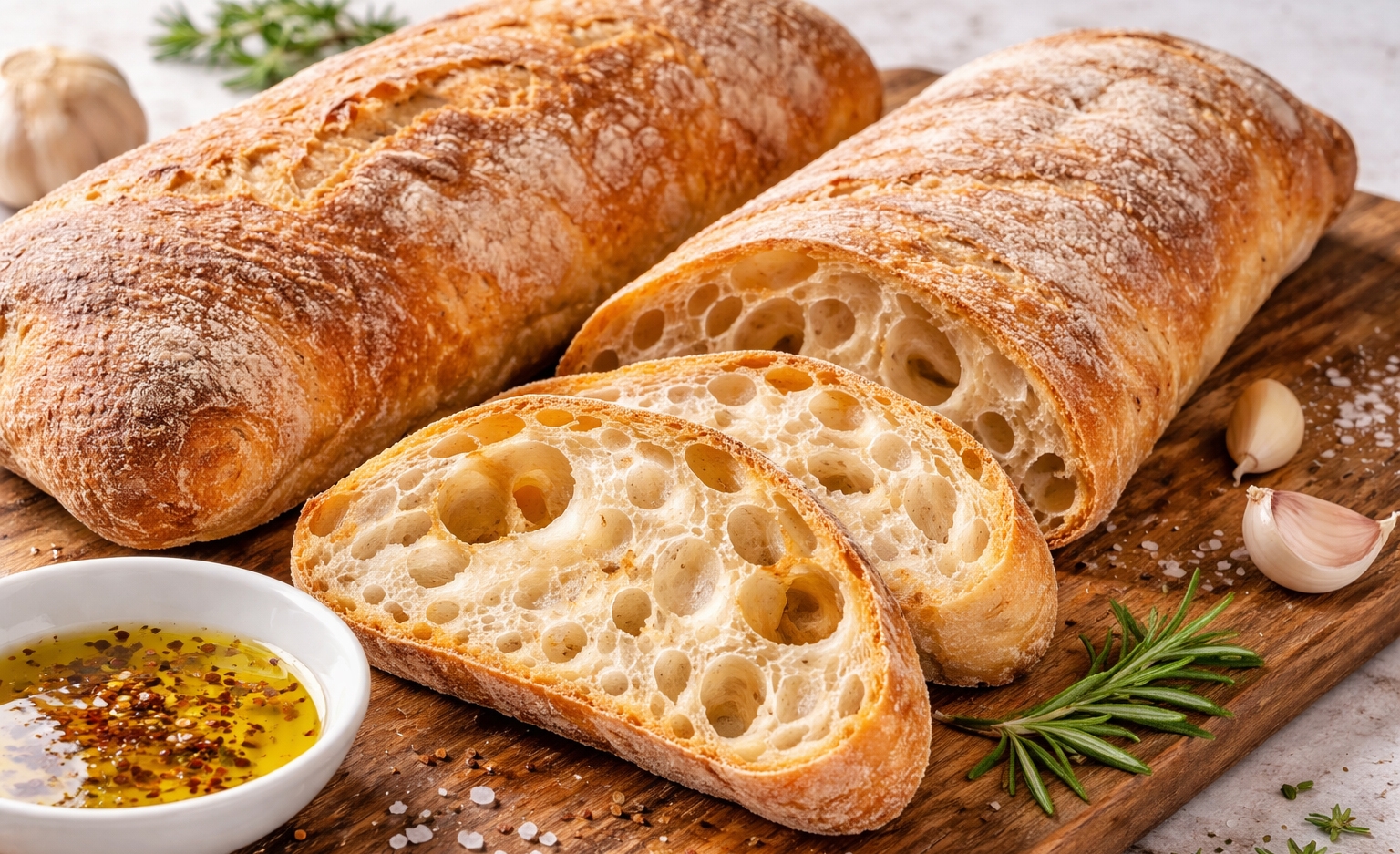
This ciabatta bread recipe produces a rustic Italian loaf with a crispy crust and soft airy interior. Known for its distinctive slipper shape and open crumb, ciabatta has become one of the most popular artisan breads worldwide.
Although many people assume ciabatta is an ancient recipe, this famous Italian bread was actually created in the 1980s. Nevertheless, bakers quickly embraced it because of its incredible flavor and texture.
In this guide, you will discover everything about this bread recipe, including its origin, baking tips, interesting facts, and a step-by-step homemade recipe.
What Is Ciabatta Bread?
Ciabatta is a rustic Italian white bread famous for its crispy crust and airy interior. The name ciabatta means “slipper” in Italian, which refers to the bread’s flat rectangular shape.
A traditional ciabatta bread stands out because of its high-hydration dough. The extra water helps create the large air pockets that make ciabatta light and chewy.
Ciabatta bread is commonly used for:
- Italian sandwiches
- Panini
- Bruschetta
- Garlic bread
- Olive oil dipping
Because of its versatility, many home bakers search for a reliable ciabatta bread recipe they can bake in their own kitchen.
History and Origin of Ciabatta Bread
The modern recipe has an interesting history.
The Baker Who Invented Ciabatta
Italian baker Arnaldo Cavallari invented ciabatta in 1982 in the Veneto region of Italy.
At the time, French baguettes were dominating the sandwich market in Europe. Therefore, Cavallari wanted to create an Italian bread that could compete with the baguette while maintaining Italian baking tradition.
After experimenting with fermentation and hydration levels, he developed the airy loaf that later became the famous ciabatta bread .
Regional Variations of Ciabatta
After its creation, the ciabatta bread spread quickly across Italy. Different regions began producing their own variations.
Popular versions include:
- Ciabatta Polesana – lighter crumb and softer crust
- Ciabatta Romana – darker crust and more hydration
- Ciabatta Toscana – sometimes made without salt
Despite regional differences, every version keeps the same rustic shape and airy interior.
Why This Ciabatta Bread Recipe Works
This homemade ciabatta bread recipe succeeds because it follows traditional artisan techniques.
Key Elements of a Good Ciabatta Bread Recipe
- High hydration dough creates the airy crumb structure
- Stretch and fold technique strengthens gluten without overworking the dough
- Long fermentation develops deeper flavor
- Hot oven baking produces the crispy crust
Because of these techniques, this ciabatta bread recipe produces bakery-quality bread at home.
Key Ingredients for Ciabatta Bread
Ciabatta uses only a few ingredients, but each one plays an important role.
Essential Ingredients
- All-purpose flour – provides structure
- Instant yeast – helps the dough rise
- Water – creates high hydration for open crumb
- Milk – adds softness and flavor
- Salt – enhances taste and strengthens gluten
Using quality ingredients will dramatically improve the results of your ciabatta bread recipe.
Homemade Ciabatta Bread Recipe
This ciabatta bread recipe uses a sponge starter that ferments overnight. This step improves both flavor and texture.

Authentic Ciabatta Bread Recipe

Equipment
- Stand Mixer
- Dough hook
- Baking stone
- Bench scraper
- Parchment paper
Ingredients
For the Sponge
- 1 cup 130 g all-purpose flour
- ⅛ teaspoon instant yeast
- ½ cup 120 ml water, room temperature
For the Dough
- 2 cups 260 g all-purpose flour
- 1½ teaspoons salt
- ½ teaspoon instant yeast
- 1 cup 240 ml water, room temperature
Optional:
- Replace 60 ml of the water with 60 ml milk for a softer crumb.
Instructions
Step 1 – Prepare the Sponge
- In a medium bowl combine the flour, yeast, and water. Stir until a sticky dough forms. Cover tightly with plastic wrap and let it ferment at room temperature for 8–24 hours until bubbly and aromatic.
Step 2 – Mix the Dough
- Place the sponge, flour, salt, yeast, and water into the bowl of a stand mixer fitted with the paddle attachment. Mix on low speed until a shaggy dough forms, about 1 minute.
- Increase speed to medium-low and mix for 4–6 minutes until the dough becomes a uniform mass and begins pulling away from the bowl.
Step 3 – Knead
- Switch to the dough hook and knead the dough on medium speed for 8–10 minutes until smooth and shiny. The dough will remain very sticky, which is normal for ciabatta.
Step 4 – First Rise
- Transfer the dough to a lightly oiled bowl. Cover and let rise at room temperature until doubled in size, about 1 hour.
Step 5 – Stretch and Fold
- Using a lightly oiled spatula, fold the dough over itself 8 times by lifting and folding the edges toward the center.
- Cover and rest for 30 minutes.
- Repeat the folding process once more and allow the dough to rise another 30 minutes until doubled.
Step 6 – Preheat Oven
- Place a baking stone on the lower-middle oven rack and preheat the oven to 450°F (230°C) about 1 hour before baking.
Step 7 – Shape the Loaves
- Turn the dough onto a floured surface without deflating it. Divide into two pieces.
- Shape each piece gently into a 12 × 6 inch rectangle, then fold the sides inward like a letter to form a 7 × 4 inch loaf.
- Place each loaf seam-side down on floured parchment paper. Cover loosely and let rest 30 minutes.
Step 8 – Prepare for Baking
- Using floured fingertips, gently stretch each loaf to about 10 × 6 inches. Lightly spray the surface with water.
- Transfer the parchment with the loaves onto the hot baking stone.
Step 9 – Bake
- Bake for 22–27 minutes until the crust is deep golden brown and the internal temperature reaches 210°F (99°C).
- Spray the loaves lightly with water twice during the first 5 minutes to create steam.
Step 10 – Cool
- Transfer the bread to a wire rack and allow it to cool for at least 1 hour before slicing.
Notes
- Ciabatta dough is very wet and sticky, which helps create the classic open crumb.
- Avoid adding extra flour during mixing.
- Using a baking stone improves oven spring and crust texture.
- For authentic Italian ciabatta, use water only instead of milk.
Tips for Baking Perfect Ciabatta Bread
Even experienced bakers can struggle with ciabatta. However, these tips will help you master this ciabatta bread recipe.
Important Baking Tips
- Do not add too much flour – sticky dough is essential
- Handle dough gently – preserve the air bubbles
- Use a baking stone – improves oven spring
- Add steam in the oven – creates a crispy crust
- Allow bread to cool completely – helps the crumb set
Following these tips will significantly improve your ciabatta bread recipe results.
Common Mistakes When Baking Ciabatta
Many beginners make a few common mistakes when trying a ciabatta bread recipe.
Mistakes to Avoid
- Adding extra flour to sticky dough
- Over-kneading or over-handling the dough
- Baking at a temperature that is too low
- Skipping the steam during baking
Avoiding these issues will help you achieve the airy crumb ciabatta is known for.
How to Serve Ciabatta Bread
This ciabatta bread recipe creates bread that works perfectly for many dishes.
Popular serving ideas include:
- Panini sandwiches
- Toasted bruschetta with tomatoes and olive oil
- Garlic bread
- Soup accompaniment
- Olive oil dipping bread
Because of its airy crumb, ciabatta absorbs flavors beautifully.
How to Store Ciabatta Bread
Fresh ciabatta tastes best the day it is baked. However, you can store leftover bread easily.
Storage Tips
- Room temperature: store wrapped for up to 3 days
- Freezer: freeze tightly wrapped for up to 1 month
- Reheating: warm in a 450°F oven for 6–8 minutes
These storage tips will help keep your ciabatta bread recipe fresh longer.
Frequently Asked Questions
Why is ciabatta bread so airy?
Ciabatta has high hydration dough, which creates large air pockets during fermentation and baking.
Why is my ciabatta dense?
Dense ciabatta usually happens when too much flour is added or when the dough is handled too aggressively.
Can ciabatta dough be made ahead?
Yes. Many bakers allow the dough to ferment overnight to improve flavor and texture.
Final Thoughts
This traditional ciabatta bread recipe proves that simple ingredients can produce incredible results. With its crispy crust and airy crumb, ciabatta remains one of the most beloved Italian breads worldwide.
Once you learn the techniques behind high-hydration dough, baking ciabatta at home becomes both fun and rewarding.
Whether you use it for sandwiches, bruschetta, or dipping in olive oil, this ciabatta bread recipe will quickly become a favorite in your kitchen.