
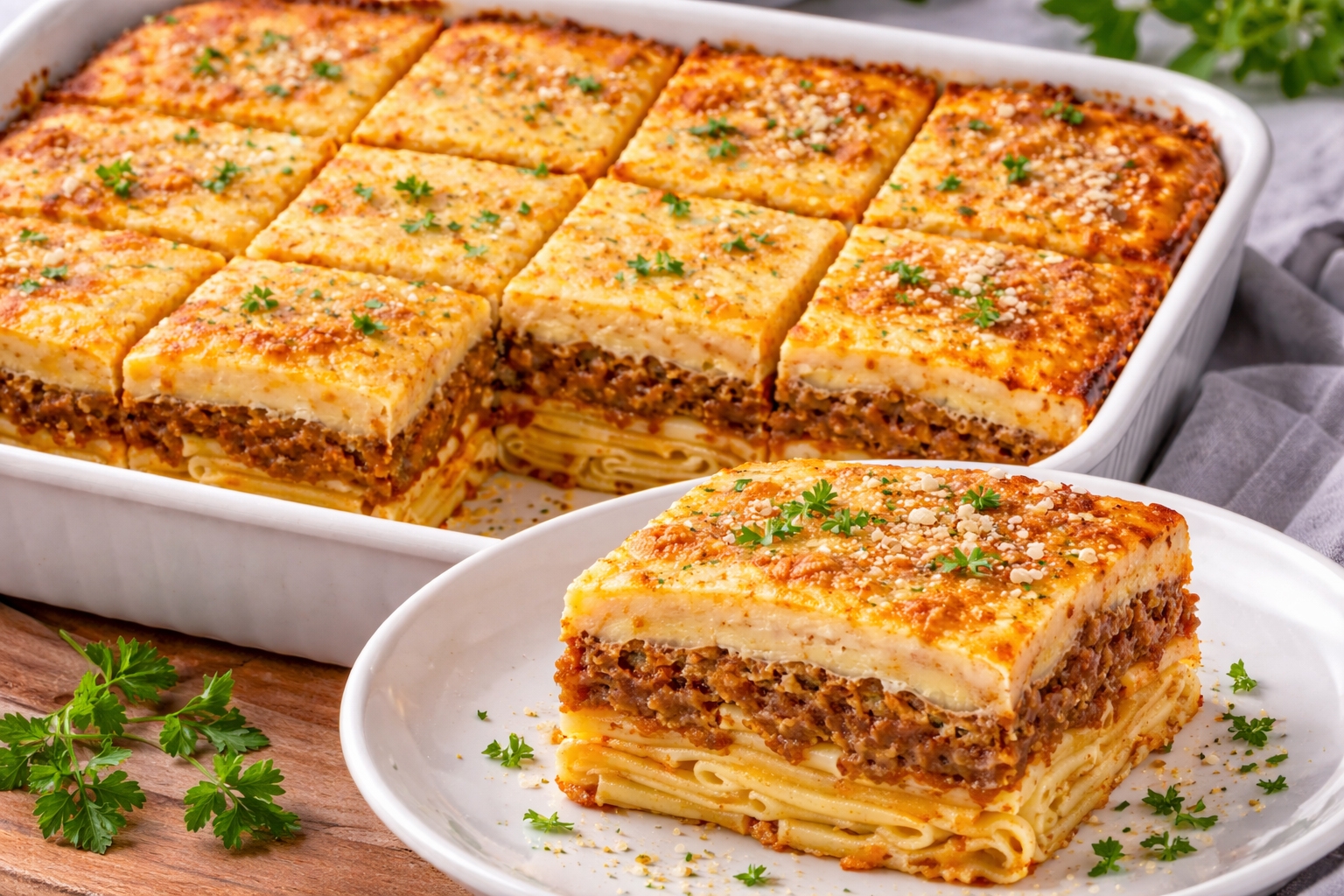
Today, we step into the heart of Greek cooking, where food carries memory, tradition, and the quiet comfort of family meals. This classic Greek Pastitsio is a perfect example of such tradition. If you’re searching for an authentic Greek pastitsio recipe, this dish represents the balance that defines Greek home cooking—generous, comforting, and thoughtfully prepared. A proper Greek pastitsio recipe connects simple ingredients with careful technique, creating a meal meant to be shared.
Before cooking, it’s worth understanding its roots. Greek pastitsio—pronounced pah-STEE-tsee-oh—has long held a central place on family tables across Greece. Home cooks prepared it to nourish their families, layering familiar ingredients with patience and care. Over time, this Greek pastitsio recipe became a symbol of togetherness, often served at gatherings, holidays, and Sunday lunches.
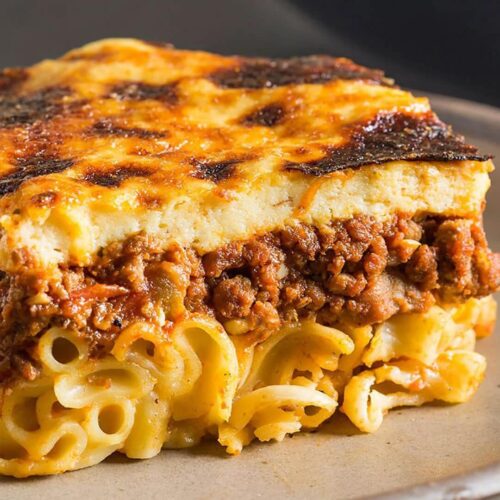
Once baked, pastitsio reveals its character. Distinct layers of pasta, richly spiced meat sauce, and smooth béchamel come together in harmony, finished with warm Mediterranean spices. The name comes from the Italian word pasticcio, meaning a medley or pie, a fitting description for a dish that brings multiple elements into a single, cohesive whole.
Although each region of Greece adds subtle variations, the essence of pastitsio remains unchanged. Learning how to prepare a traditional Greek pastitsio recipe is not about reinvention, but about honoring balance, technique, and the timeless pleasure of cooking for the people you love.
Origin of Pastitio
While the precise history of pastitsio remains unknown, its essence captures the essence of Greek hospitality and culinary artistry. Venetian tradesmen brought lasagna from Italy to Greece during the Byzantine era, according to some. Some credit the Ottoman influence for its origin, as Greek food incorporated layers of spices and fragrant plants.
Whatever its origins, pastitsio has made a name for itself in Greek society, appearing on tables for festivals, celebrations, and casual get-togethers. Every taste of it is a celebration of life’s small joys, and its reassuring perfume fills homes with nostalgia and sends diners to a world where time stops still. Above all, mastering the Greek pastitsio recipe lets you share this rich culinary legacy.
What is pastitio?
The simplest way to describe what is Pastitsio is a greek version of Lasagna. Traditional pastitsio recipe has three layers:
- First layer has a deep layer of tubular pasta.
- Second layer has a delicious meaty sauce.
- The final layer has a creamy béchamel sauce.
Pastitsio utilizes cylindrical tubes of pasta bucatini pasta or #2 Pasta, allowing for a much thicker pasta layer. Italian lasagna traditionally incorporates ricotta and mozzarella cheeses, both made of buffalo’s or more commonly cow’s milk. Below I describe the two types of cheese to make pastitsio either Kefalotyri or Graviera cheese.
GRAVIERA CHEESE

“Graviera is Greece’s second most popular cheese after Feta. The very first Graviera was produced in the country in 1914 by a cheesemaker in the Peloponnese and was based on the recipe of the Swiss Gruyère cheese (even the name itself, Graviera, is somewhat derived from Gruyère), but with one significant difference: cow’s milk was replaced by sheep and goat’s milk.”
“Since then, the recipe has evolved and was amended, while cow’s milk was also used for certain types of the cheese, so that nowadays Greek Gravieras have no connection whatsoever with the original Swiss version.”
“There are three PDO Gravieras in Greece: Graviera Agrafon (produced in Western Thessaly and Evritania), Graviera Kritis (produced in Crete) and Graviera Naxou (from the island of Naxos in the Cyclades). Production of exceptional Graviera cheese –although not registered as PDO– also takes place in the islands of Tinos (from cow’s milk), Lesvos, as well as in the region of Epirus and the municipality of Amfilochia.”
“In conclusion, Graviera is a cheese with a big “personality” and a great variety –from sweet to very spicy– to fit every taste.” Excerpt from Ambrosia Magazine
KEFALOTYRI CHEESE

“Kefalotyri (also spelled kefalotiri) is a traditional Greek cheese made from sheep’s milk and/or goat’s milk in Greece and Cyprus, with origins dating back to the Byzantine era. Typically, it appears as a hard, light-yellow cheese with a sharp flavor and dry texture. Depending on the milk blend, its color ranges from white to deep yellow.
Producers age young kefalotyri for at least two to three months, while they mature older versions for a year or longer, developing a drier texture and a more intense, salty flavor. In taste, kefalotyri resembles Gruyère; however, it delivers a firmer bite and noticeably more saltiness.
Cooks use kefalotyri both fresh and cooked, adding it to pasta, meat, and vegetable dishes. Traditionally, they also fry it in strips or cubes to make saganaki. On cheeseboards, kefalotyri pairs beautifully with seasonal fruits such as pears, figs, and grapes, and it complements red wine and sausages exceptionally well.
WHAT INGREDIENTS YOU NEED TO MAKE PASTITSIO
- #2 Pasta or substitute
- Graviera or Kefalotyri cheese
- Mince Meat
- Red or White Onions
- Garlic
- Tomato Passata
- Various herbs and spices
- Olive Oil
- Butter
- Flour
- Eggs
- Milk
As the aroma of freshly baked pastitsio fills your kitchen. Take a moment to appreciate the simple joys of good food and shared memories. This timeless Greek classic is sure to warm your heart and nourish your soul. The effort required to prepare this iconic dish for the family or savored solo is well worth it. This is the ultimate Greek comfort food, along with the legendary traditional Greek Moussaka of course! So grab your loved ones, lift your glasses, and enjoy every mouthwatering morsel of this delectable comfort dish.
Classic Greek Pastitsio

Equipment
- ☐ Baking pan (20 × 32 × 6 cm)
- ☐ Large pot
- ☐ Medium saucepan
- ☐ Large pasta pot
- ☐ Fine whisk
- ☐ Wooden spoon or heatproof spatula
- ☐ Chef’s knife
- ☐ Cutting board
- ☐ Measuring cups and spoons
- ☐ Colander
- ☐ Mixing bowls
- ☐ Oven
- ☐ Ladle
Ingredients
Pasta Base
- 450 g #2 pasta or bucatini, penne, or ziti
- 4 tbsp unsalted butter
- 2 egg whites
- ¼ cup grated kefalotyri cheese
Meat Sauce
- 750 g ground meat 50% beef, 50% pork
- 1 medium red onion finely chopped
- 1 garlic clove finely chopped
- 650 g tomato passata
- 2 tbsp tomato paste
- ½ tsp ground cinnamon
- ¼ tsp ground cloves
- ¼ tsp ground allspice bahari
- 1 tsp dried oregano
- 1 bay leaf
- 3 tbsp olive oil
- ½ cup red wine
- Salt and freshly ground black pepper to taste
Béchamel Sauce
- 1.2 liters whole milk
- 120 g unsalted butter
- 120 g all-purpose flour
- 4 egg yolks
- 2 egg whites
- ½ cup grated kefalotyri cheese
- ¼ tsp freshly grated nutmeg
- Salt and white pepper to taste
Instructions
Meat Sauce
- Place the 3 tbsp of olive oil into pot and set to high heat.
- Sautee meat until brown, approx 15 minutes. Make sure all moisture has evaporated before adding onion and garlic.
- Add in the onion and garlic, sautee about 5 minutes.
- Add the tomato paste and cook for about 2 -3 minutes.
- Deglaze by adding in the red wine, let the alcohol content evaporate.
- Add in the spices and tomato sauce, stir well.
- Bring to a simmer and allow to cook about 40 minutes.
Base
- Cook the pasta 3 minutes before fully cooked.
- After cooking them, drain and place pasta aside.
- Add 4 tblsp of butter (not salted) and mix well.
- ¼ cup of kefalotyri and set aside.
- Beat egg whites and set aside.
Beschemel Sauce
- Place pot on low-medium heat and add the butter.
- Melt the butter until bubbles form on top, do not allow to get too hot.
- Add in the flour all at once.
- Stir continuously, do not let the butter burn, but bring the mixture to a golden, nutty color, about 2-3 minutes.
- Lower the heat, slowly add in the milk while stirring with a whisk to avoid lumps. Mix into a creamy sauce and bring to a low boil.
- Add the kefalotyri and the nutmeg, salt and white pepper and mix well.
- Once it is bubbling take pot off the heat.
- Add in the egg yolks and mix thoroughly and carefully.
Asembling your Pastitsio
- In an oiled baking dish (25 by 32cm or 9 by 13in) assemble your pastitsio.
- Use the egg whites, and kefalotyri cheese, and mix well into the pasta.
- Add the pasta evenly in the pan.
- Add the meat sauce into the pan and spread evenly over the pasta.
- Add bechamel on top and spread evenly.
- Sprinkle ¼ cup kefalotyri on top of the sauce and place into oven.
- Cooking time 45 minutes to 1 hour or until golden brown at 180 – 200 c or 350 – 380 f.
Notes
- Pasta should never be fully cooked because it will become mush in the pan while baking. It will cook itself in the pan and will come out perfect.
- An old school cook told me once to combine the egg whites with the pasta to ensure the pasta doesn’t break apart when you cut out a piece from the pan when cooked.
- This recipe is an old tried and true recipe. I have used it in my deli business years ago and it was very successful. Try it and you’ll like it!



Hello! I simply would like to offer you a huge thumbs up for the great information you have right here on this post. I will be coming back to your blog for more soon.